
The explosion of the supernova SN 2023ufx in a dwarf galaxy 215 million light years away from us has shown that the theory of stellar evolution does not correspond to reality. In this exploded star and in general in its entire galaxy there were almost no so-called metals, there were mainly hydrogen and helium.
This is one of many supernovae, in the products of which only hydrogen and helium are detected, which rejects the theory of the cause of supernova explosions by the exhaustion of hydrogen reserves for thermonuclear reactions. But it also shows that hydrogen and helium are formed in the world of galaxies continuously and constantly, and did not originate in the “big bang”. That is, defining stars with a low metal content as ancient stars that arose from the products of the “big bang” is a systematic error.
Another example of a hydrogen emission without metals is an ordinary supernova, which in 2022 produced a powerful gamma-ray burst GRB 221009A, called BOAT (Brightest Of All Time). It turned out to be, according to calculations, 2.4 million light years from us. But it was not the powerful gamma-ray burst that confused cosmologists, but the complete absence of heavy elements after the explosion of this supernova! Theorists expected to find a scattering of such elements around the BOAT source. But, having studied the “scene”, scientists discovered that they were not there. It must be said that “black holes” also emit jets containing only protons and electrons, that is, hydrogen in the form of plasma. Jets hydrate carbon monoxide from dust clouds that they encounter, creating hydrocarbons in this area. That is, in the world of galaxies there are always places where hydrogen-helium stars are formed in gas clouds poor in metals. Examples of such stars: Caffau, Methuselah…
The Caffau star (SDSS J102915+172927) was discovered by Elisabetta Caffau, it is the most metal-poor star in the Milky Way (of those known). It is located in the constellation Leo. The mass of the Caffau star (about 0.8 solar masses), its metallicity (more than 20,000 times less than that of the Sun). “The Gaia mission provided its very precise parallax, which allowed us to calculate the distance to the Caffau star, which turned out to be between 4076 and 4957 light years. According to the existing theory, it should not exist in principle, since it does not fit into the theorists’ models of star formation.
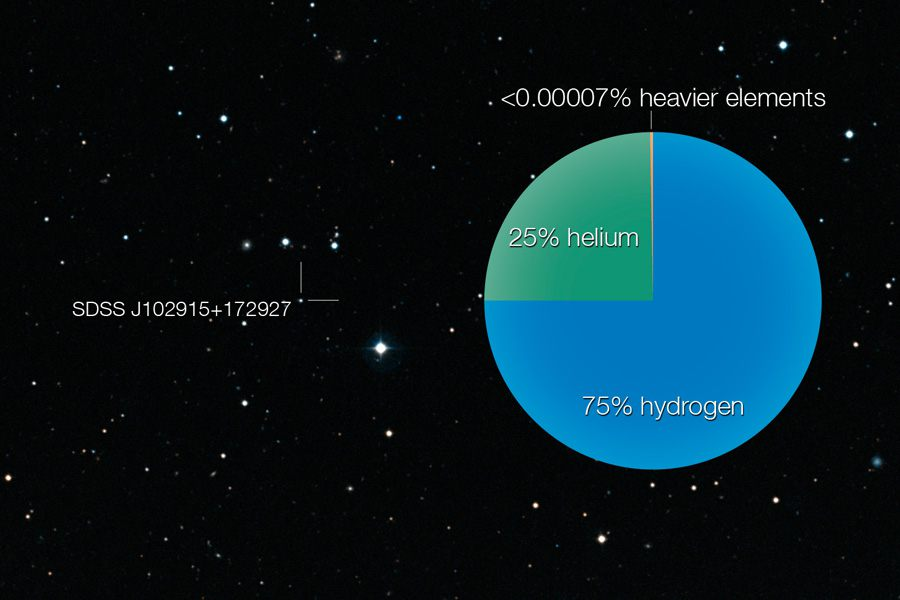
Composition of the Caffau star (SDSS J102915+172927). Credit: ESO/DSS2
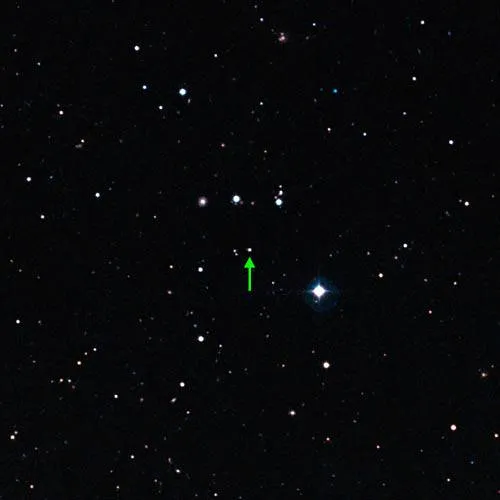
The Kaffau Star
The authors of the discovery of SDSS J102915+172927 say that it may not be so unique after all. Their observational data includes several other candidates with such an unusual composition – or even lower metallicity than it.
Takahiro Morishita, a researcher at the Infrared Processing and Analysis Center (IPAC) at the California Institute of Technology, an ardent proponent of the “big bang” theory, and his co-authors have found something like a tiny galaxy hidden behind and lensed by a large, ordinary, highly metallic galaxy. They found this something at a redshift of z = 5.725, which means, on the distance scale invented by theorists, that the light from there was emitted when about 1 billion years had passed after the “big bang.” The microgalaxy was named AMORE6. And proponents of the “big bang” theory began to dance with tambourines around this cloud of hydrogen, declaring that it was the primordial product of the “big bang” …